Other notes:
VRML (Virtual Reality Modeling Language)
is a solid and royalty-free standard for interactive
3D environments, that in the recent years has extented
it's range of application beyond rather simple web-based
3D scenes (what was the case until the end of 1990-ties).
VRML has text based (optionally binary
compressed) file format, that allows easy generation
from any script based server/client technology. VRML
is often used as exchange format between many 3D applications.
The VRML viewer BS Contact, that
I am using - runs only on PC platform, but is the currently
the most advanced VRML viewer in terms of features and
visual quality of the image, that in many aspects rivals
some of the best game engines and other high-end VR set-ups.
There is interesting, and not so often
explored possibility of using streaming media content
in interactive VRML and even mix several sources in one
scene.
Other very interesting feature is ability
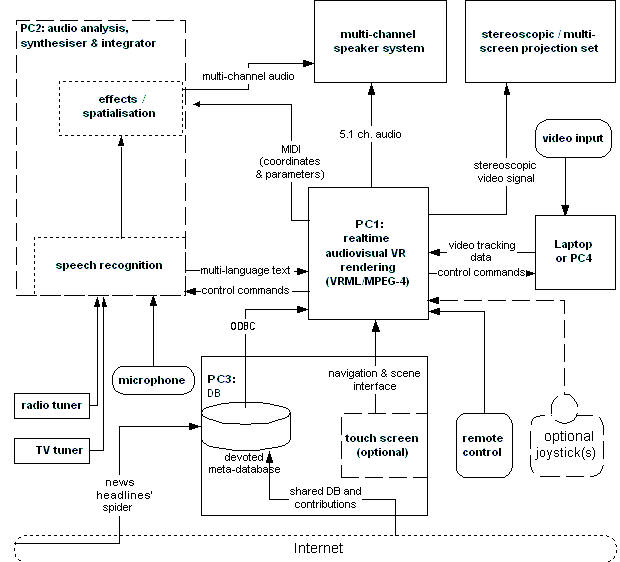
to play multi-channel sound by the newest versions of streaming
codex v9 from RealNetworks and Microsoft Media – they allow
to use e.g. 5.1 or 7.1 channel sound.
During my collaboration with the developers
of BS Contact viewer at the company Bitmanagement
Software in
the recent years - I have implemented several specific
custom-made plug-ins, that extends the features with
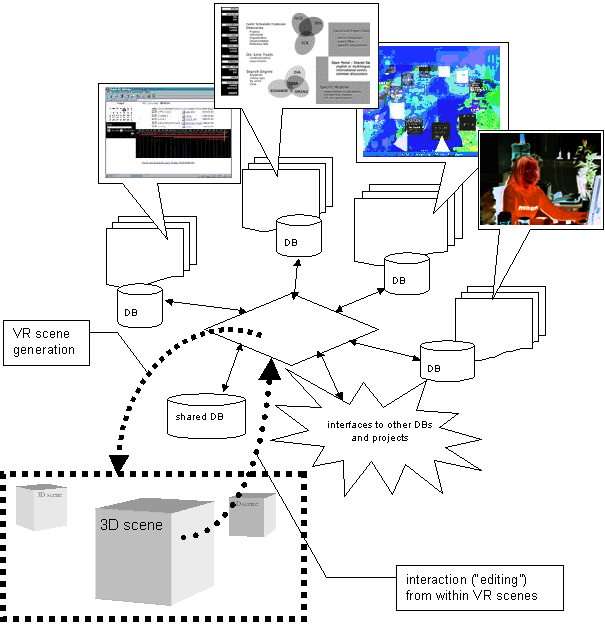
interfaces for MIDI in/out, ODBC (Open Data Base Connectivity)
and multi-client sinchronisation. I also have obtained
a license for SDK, that would permit to develop further
interfaces and extensions, eg. OSC (Open Sound Control)
or possibly direct realtime live-video input (video-overlay
speed) textures.
in
the recent years - I have implemented several specific
custom-made plug-ins, that extends the features with
interfaces for MIDI in/out, ODBC (Open Data Base Connectivity)
and multi-client sinchronisation. I also have obtained
a license for SDK, that would permit to develop further
interfaces and extensions, eg. OSC (Open Sound Control)
or possibly direct realtime live-video input (video-overlay
speed) textures.
 metaSpongia (proposal)