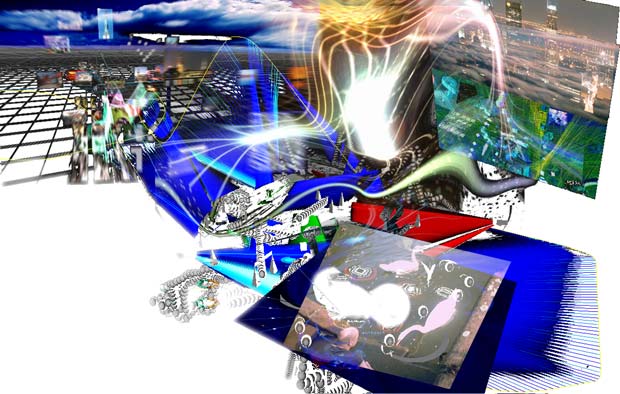
Virtual (3D) scenes
from a meta-database, audiovisual assets (or data
streams) and locative information, mixing common
2D, 2.5D, 3D and special stereoscopic imagery, synthesized
3D sound.
Images and video sequences
in the data base are analysed for:
1) average color
properties
2)
texture / pattern segmentation (at lest basic indexing)
3) pixel properties across the edges and a 'connection
map' options are generated
4) access statistics
(material usage, references in
other projects)
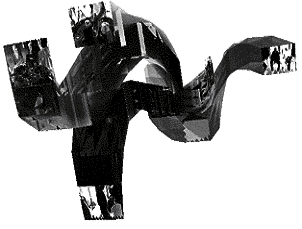
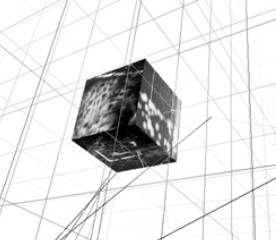
arbitrarily defineable 'connections' are visualised
as spatial moving sculptures,
consisting of dense 'tissues' of the illusory space.
The surface of image grows into spatial objects,
materiality.
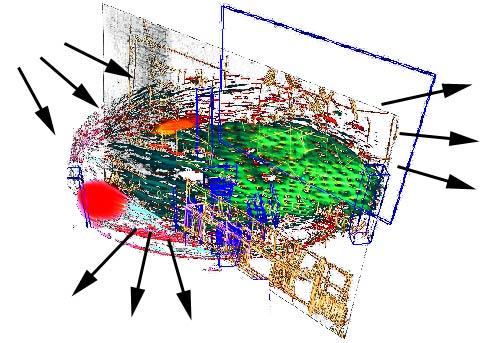
The stereoscopic effects is also created by mapping
images onto cell-like, convex and concave 3D shapes
and skewed planes, so that sometimes somewhat paradoxical
spatiality is achieved through combination of various
perspectives and stereoscopc depth illusion. Multipe
virtual cameras generate also "endo perspective" views -
where some angle of the scene part can becomes
a new dynamic image re-used in nearby scene. Sound
channels from various sources are remixed into
spatial soundscape.
3D scene are constructed from "cells" of
related, juxtaposed and superimposed images
and video seqences and sound tracks. For chosen
sequences perform video tracking process (e.g.
follow some pattern presence or movement registration),
convert data to space/time coordinates and create
spatial structures and animated modifications
of the surface properties (e.g. a "butterfly
to earthquake" effect in the VR world) The
sound material also can be mixed, panned (moved)
in 3D space, apply real-time effects, related to
image modifications.
scenes are "bridged", "nested
into each other", real footage mixed with abstracted
computer structures - extracted paths from moving
objects leave patchwork of traces, creating fluid
landscapes, where the "activity" of object detail
gets "inverted" into a "frozen spatial mutation".
The user can initiate image mutations in several
"dimensions", that get calculated "in background"
and gradually update (change scenes).
The navigation
possible with help of touchscreen (which indicates
a "map" of explored and unexplored variations,
or switch to new scene generation, and adjust parameters)
and/or conventional game pad/joystick.
Alternatively(or additionaly) as a performance
with sophisticated input devices like data glove
by author(s). ( In this case it resembles "virtual
surgery" of "audiovisual
tissues" of the VR scenes)
Concluding:
the proposed work is an experiment without an entirely
predictable result. It could make an impression
ranging from of a fascinating cinematic 'ambient audiovisual
landscape', live painting, to a portrait of a breathing
organism, or to extreme (overloaded,
explosive) game
experience. Due it's integration in the shared
database, and more or less direct manipulation
of several users, the work could have dual or triple
presentation form: as a stand-alone installation,
as a side-by-side extension to connected installation
(game environment, for instance), and a (streaming)
video content generating "tool".
Some
of the media cross conversion might be done "manually",
some "automated", but the interaction/navigation
in the VR would be smothly realtime.
 metaSpongia (proposal)